A slender stem flaring into a fluted canopy, in the spirit of Frank Lloyd Wright’s Johnson Wax columns and Félix Candela’s umbrellas, repeated into a forest. One loft through three sections makes a column; two Linear Array components plant the forest.
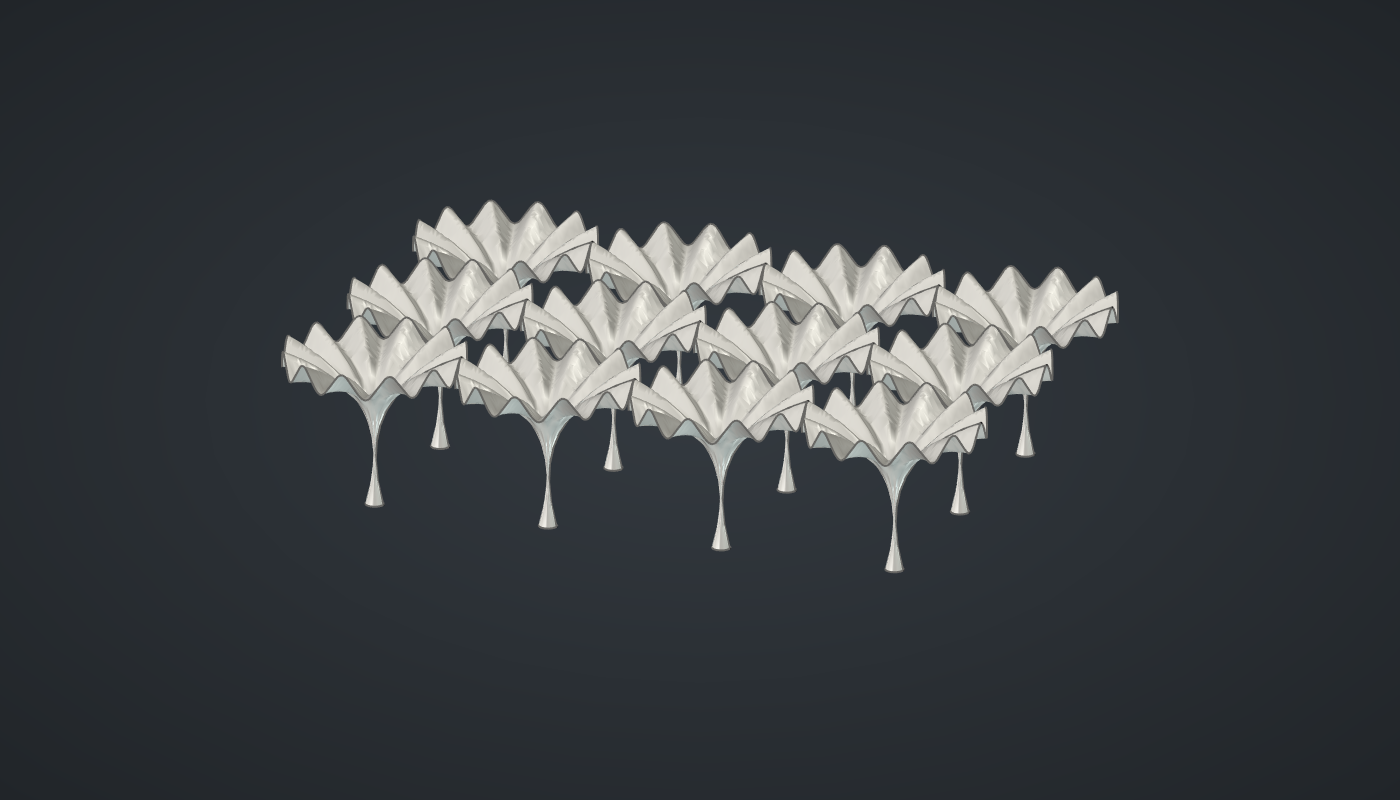
Reference: choose on the canvas toolbar to load the finished definition.
Build it
Three sections
-
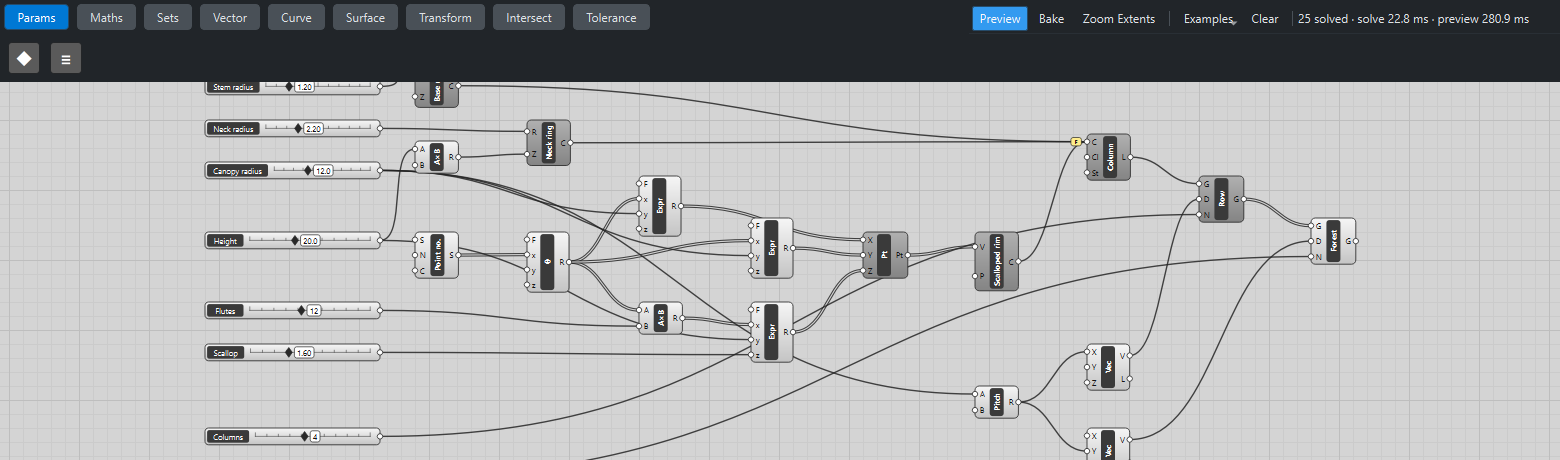
Place eight sliders: Stem radius: 1.2 (0.4 – 4), Neck radius: 2.2 (0.5 – 6) and Scallop: 1.6 (0 – 5) with Decimals
2; Canopy radius: 12 (5 – 25), Height: 20 (8 – 40); and Flutes: 12 (3 – 24), Columns: 4 (1 – 8), Rows: 3 (1 – 8) with Decimals0. -
Place a Circle (Curve), Base ring, with Stem radius → R.
-
Place a Multiplication (Maths) with B
0.7after Height, and a Circle, Neck ring, with Neck radius → R and the Multiplication → Z. -
For the scalloped rim, place a Series (Sets) with C set to
48, an Expression (Maths), θ,2*pi*x/48, and a Multiplication of θ by Flutes. -
Place three Expression components:
-
y*cos(x)andy*sin(x), with θ → x and Canopy radius → y; -
y + z*cos(x), with θ × Flutes → x, Height → y and Scallop → z. -
Wire them into a Construct Point (Vector).
-
-
Place an Interpolate (Curve) with P set to
True: the scalloped rim, rising and falling Flutes times.
One column, many columns
-
Place a Loft (Surface) and wire three curves into its C: the base ring, then (holding Shift) the neck ring, then the rim. Tick Flatten on C. Several wires into one input merge their data in the order they were connected.
-
Place a Multiplication with B
2after Canopy radius: the spacing. Place two Vector XYZ (Vector) components, one with the spacing in X and one in Y. -
Place a Linear Array (Transform), Row: Loft → G, the X vector → D, Columns → N. Place a second, Forest: Row → G, the Y vector → D, Rows → N.
-
Turn Preview off on the rings, rim, Loft and Row.

What is happening
A loft passes a smooth surface through its sections in order, so the stem flares through the neck to the canopy, and the scalloped rim makes the flutes run all the way down into the neck. The second Linear Array receives a list of columns and copies each one, which is how one array of arrays makes a grid. The spacing is twice the canopy radius, so neighbouring rims touch at their widest points. The geometry tests check that the rim passes through its scallop peaks at Height + Scallop.
The forest solves in a few hundredths of a second; drawing twelve fluted canopies takes about two thirds of a second. The rim has 48 points: 96 made each canopy five times slower to draw for no visible gain.
Things to try
-
Set Flutes to 6 for bold lobes, or to 20 for fine pleats; set Scallop to 0 for a smooth bowl.
-
Raise Height to 35 for tall, slender columns.
-
Set Columns and Rows to 6 for a hypostyle hall.
-
Make Neck radius larger than Canopy radius for an hourglass instead of a mushroom.