A hole of diameter .505 to .510 is located with a position tolerance of ⌀.005 at MMC. How much extra (bonus) tolerance does a hole get as it is made larger, and what are its worst-case boundaries? The numbers come from G. R. Cogorno, Geometric Dimensioning and Tolerancing for Mechanical Design (3rd ed.), Table 3-2.
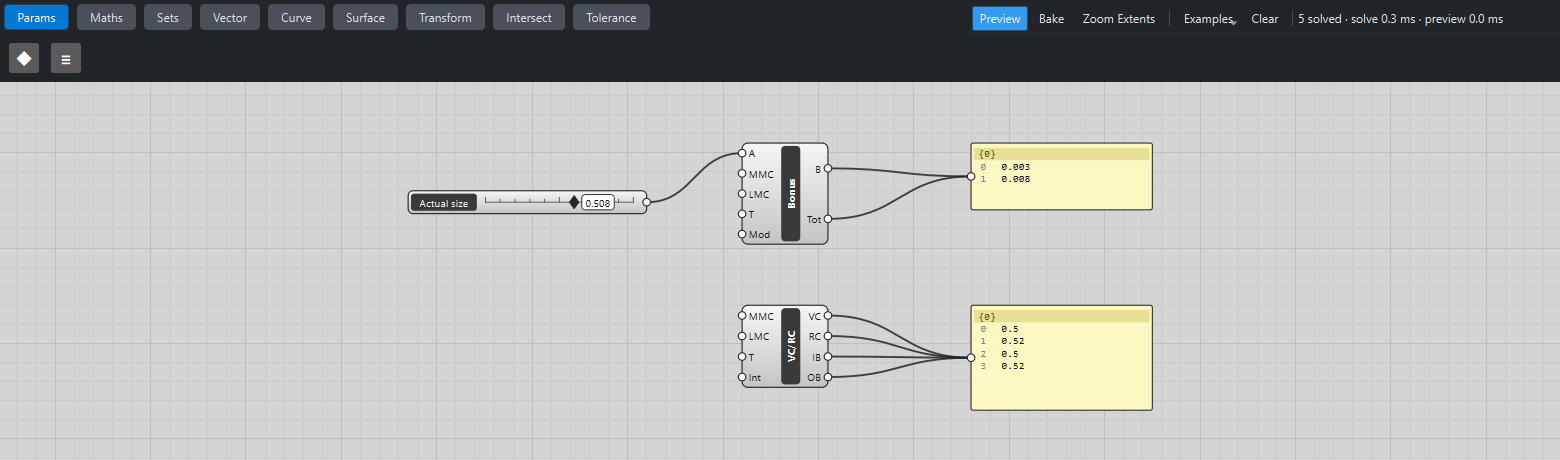
Reference: choose on the canvas toolbar to load the finished definition.
Build it
-
Place a slider Actual size: 0.508 (0.505 – 0.510) with Decimals
3. -
Place a Bonus Tolerance (Tolerance). Wire Actual size → A. With Set value…, set MMC to
0.505, LMC to0.510and T to0.005. Leave Mod atMMC. -
Place a Virtual & Resultant Condition (Tolerance). Set MMC
0.505, LMC0.510, T0.005, and leave Int (internal) atTrue, because a hole is an internal feature. -
Place two Panels: wire Bonus B and Tot into one, and VC, RC, IB and OB into the other.
Read the results
At an actual size of .508 the hole has departed .003 from its MMC of .505, so it gains a bonus of .003 and its total position tolerance is .005 + .003 = .008. Drag the slider and compare with Cogorno’s table:
| Actual size | Bonus | Total position tolerance |
|---|---|---|
.505 (MMC) |
.000 |
.005 |
.506 |
.001 |
.006 |
.507 |
.002 |
.007 |
.508 |
.003 |
.008 |
.509 |
.004 |
.009 |
.510 (LMC) |
.005 |
.010 |
The boundary calculator gives:
-
Virtual condition .500 = MMC − tolerance: the constant boundary a mating pin must clear (the gauge pin size).
-
Resultant condition .520 = LMC + tolerance + size tolerance: the worst-case outer boundary, which decides the minimum wall thickness around the hole.
For a hole the inner boundary is the virtual condition and the outer boundary the resultant condition; for a pin it is the other way round.
Things to try
-
Set Mod to
RFS(regardless of feature size): the bonus is always zero. -
Set Mod to
LMC: the tolerance now applies at the largest hole, and the bonus grows as the hole gets smaller. -
Model the matching pin: on the boundary calculator set MMC
0.510, LMC0.505and IntFalse. Its virtual condition is .515 and its resultant condition .495. -
Drag the slider outside .505 – .510 by editing its range: Bonus Tolerance turns red, because an actual size outside the size limits is a rejected part, not a bonus.
See GD&T calculators for the formulas.