A hyperbolic paraboloid ("hypar") is a curved saddle made entirely of straight lines, which is why Félix Candela could build his thin concrete shells on straight timber formwork. Join points on two opposite edges of a skew quadrilateral and the lines draw the saddle; join the other two edges and a second family fits the same surface. Four rotated copies make an umbrella on a central column.
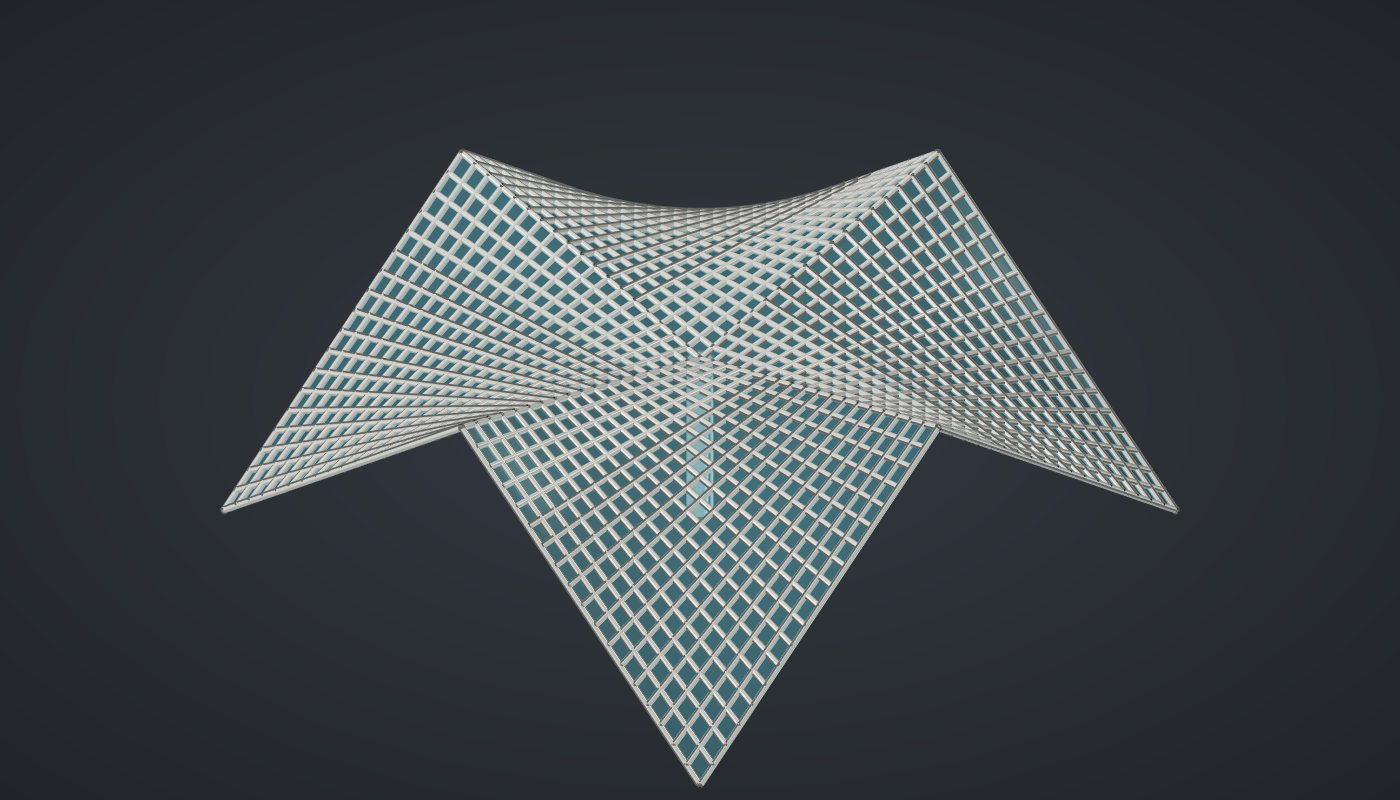
Reference: choose on the canvas toolbar to load the finished definition.
Build it
Four corners and four edges
-
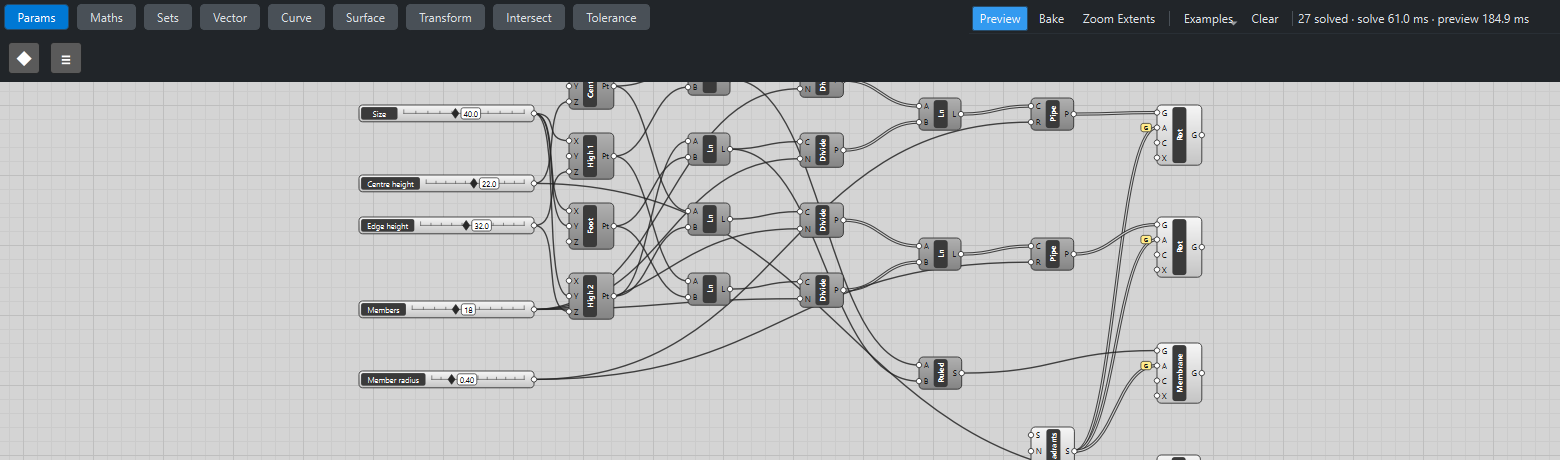
Place five sliders: Size: 40 (10 – 80), Centre height: 22 (5 – 40), Edge height: 32 (10 – 60), Members: 18 (4 – 40) with Decimals
0, and Member radius: 0.4 (0.1 – 1.5) with Decimals2. -
Place four Construct Point (Vector) components:
-
Centre: Centre height → Z.
-
High 1: Size → X, Edge height → Z.
-
Foot: Size → X and Size → Y (its Z stays 0, on the ground).
-
High 2: Size → Y, Edge height → Z.
-
-
Place four Line (Curve) components for the edges: Centre → High 1, High 2 → Foot, Centre → High 2 and High 1 → Foot (first point into A, second into B).
Two families of members
-
Place four Divide Curve (Curve) components, one per edge, and wire Members → N on all four.
-
Place a Line and wire the divided Centre → High 1 points → A and the divided High 2 → Foot points → B: the first family, 19 straight members.
-
Place a second Line between the divided Centre → High 2 and High 1 → Foot points: the second family.
-
Place two Pipe (Surface) components, one per family, with Member radius → R.
Membrane and umbrella
-
Place a Ruled Surface (Surface) and wire the edge lines Centre → High 1 → A and High 2 → Foot → B. This is the hypar itself.
-
Place a Series (Sets), Quadrants, with N set to
90and C to4: 0°, 90°, 180°, 270°. -
Place three Rotate (Transform) components, for the two Pipes and the Ruled Surface. Wire Quadrants → A on each and tick Graft on A. Every member is turned by every angle: four quadrants.
-
Place a Cylinder (Surface) with R set to
1.6and wire Centre height → L: the column. -
Turn Preview off on the points, edge lines, Divide Curves, member Lines, the unrotated Pipes and the Ruled Surface.
What is happening
The two families are built between different pairs of edges, yet both lie on the same surface: a hypar is doubly ruled. The geometry tests check this directly: the midpoint of every second-family member lies on the first family’s ruled surface to within a millionth of a millimetre.
Graft on Rotate’s angle input is what makes copies. Without it, Rotate would pair member 1 with 0°, member 2 with 90° and so on. With it, each angle is its own branch, and in each branch every member is turned by that angle. The four quadrants share their edges, so the umbrella is continuous: low at the column and the four feet, high at the middle of each side.
Each update takes about a tenth of a second to solve and a quarter of a second to draw the 150 pipes.
Things to try
-
Raise Edge height to 60 for a dramatic, steep saddle, or lower Centre height to 10 for a deep funnel.
-
Set Centre height above Edge height (40 and 10) and the umbrella turns inside out into a peaked tent.
-
Set Members to 30 for a fine grid, or to 6 for a bold one.
-
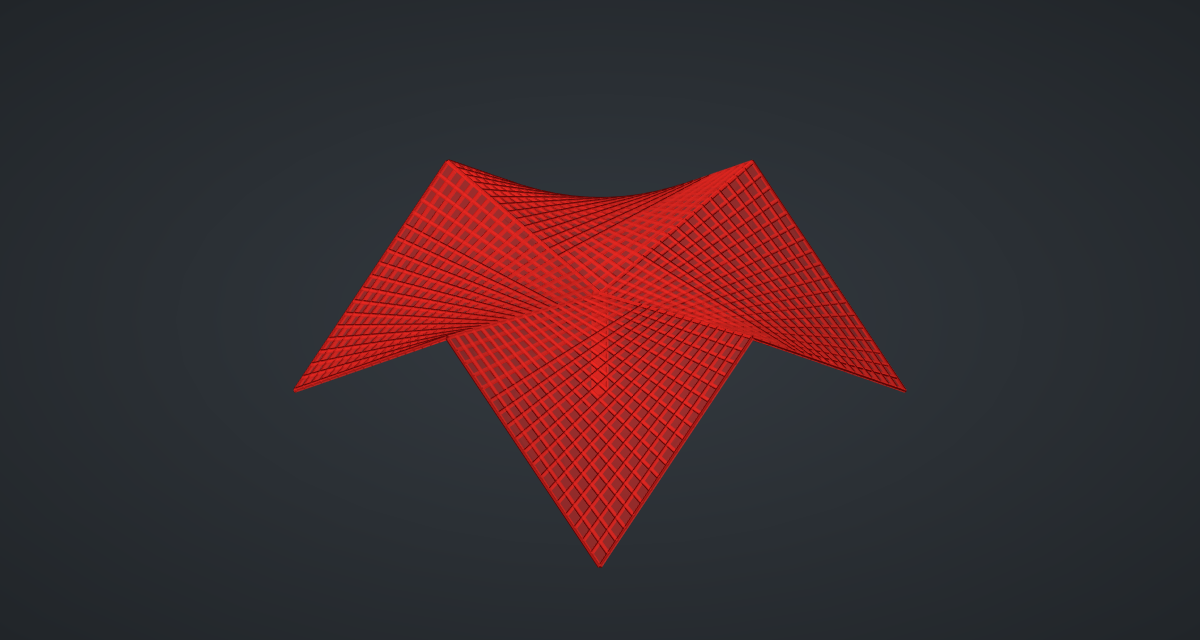
Bake the membrane and the members and colour them as in the picture: the membrane 55 % transparent.