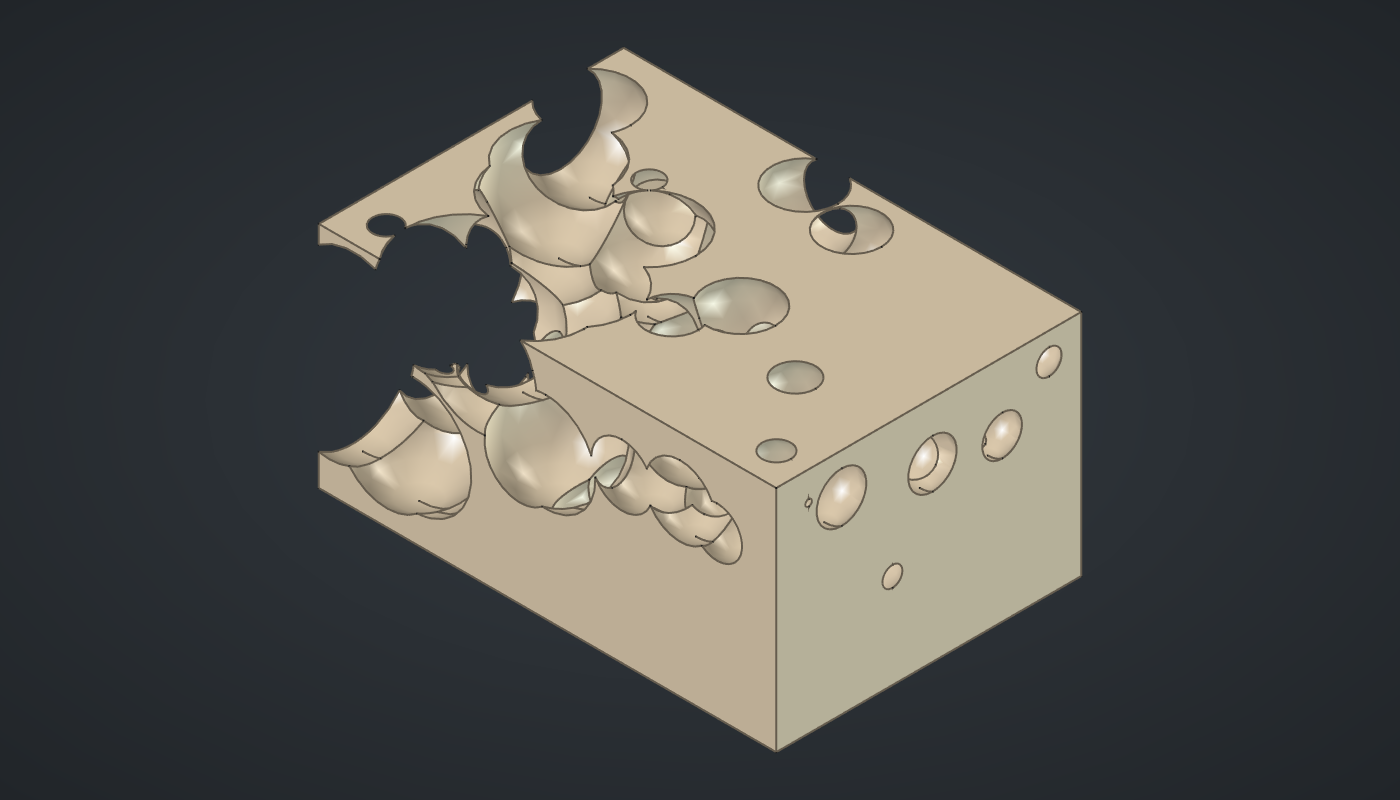
A solid block hollowed by spherical voids that grow towards one corner, as if eroded. It is the attractor idea again, this time driving solid Booleans: sixty spheres, sized by their distance to a point, subtracted from a box in a single Solid Difference.
Reference: choose on the canvas toolbar to load the finished definition.
Build it
Block and void centres
-
Place ten sliders: Width: 60 (30 – 120), Depth: 40 (20 – 80), Height: 30 (15 – 60); Voids: 60 (10 – 150) and Seed: 4 (1 – 50) with Decimals
0; Smallest void: 3 (1 – 8) and Largest void: 9 (3 – 15) with Decimals2; and Attractor X: -30 (-60 – 60), Attractor Y: -20 (-40 – 40), Attractor Z: 30 (0 – 60). -
Place a Center Box (Surface) and wire Width → X, Depth → Y and Height → Z. It is centred in X and Y and stands on Z = 0.
-
Place a Populate 2D (Vector) with R set to
1. Wire Width → W, Depth → H, Voids → N and Seed → S: void positions spread over the block’s footprint. -
Place a Deconstruct (Vector) and wire Populate P → P.
-
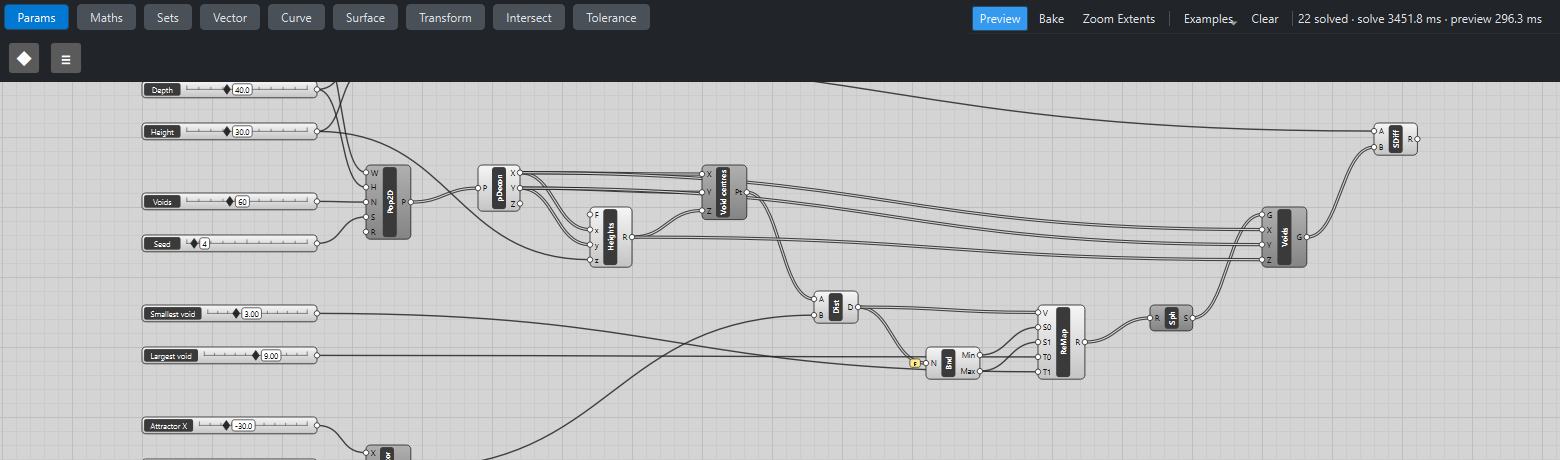
Place an Expression (Maths), Heights, with F set to
z*(0.1 + 0.8*abs(sin(x*1.7 + y*2.3))). Wire Deconstruct X → x, Y → y and Height → z: a repeatable "random" height between 10 % and 90 % of the block for each void. -
Place a Construct Point (Vector), Void centres, and wire X, Y and Heights into it.
Void sizes
-
Place a Construct Point, Attractor, and wire the three attractor sliders into it: by default the top of one corner.
-
Place a Distance (Vector) and wire Void centres → A and Attractor → B.
-
Place a Bounds (Maths) with Flatten on N, wire Distance → N, and a Remap Numbers (Maths). Wire Distance → V, Bounds Min → S0, Bounds Max → S1, Largest void → T0 and Smallest void → T1: the nearest void gets the largest radius.
Carving
-
Place a Sphere (Surface) and wire Remap R → R: 60 spheres at the origin.
-
Place a Move (Transform), Voids. Wire Sphere → G, Deconstruct X → X, Deconstruct Y → Y and Heights → Z.
-
Place a Solid Difference (Intersect). Wire Box → A and Voids G → B.
-
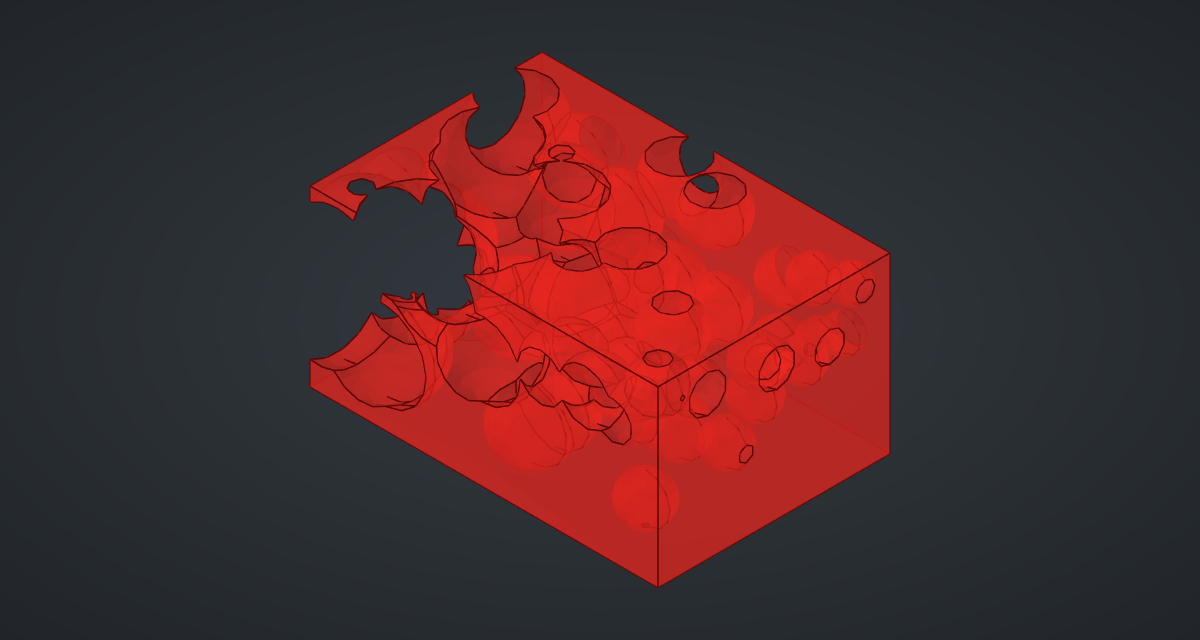
Turn Preview off on everything except the Solid Difference.
What is happening
The Solid Difference takes the box and all sixty spheres at once (its B input has list access), so OpenCascade sorts out every intersection between the voids in one operation. Spheres that overlap merge into larger caverns; spheres that cross a face of the block leave craters. The geometry tests check the volume against an independent calculation: the block minus its overlap with all the spheres fused together.
With more or larger voids near the corner, the cavities can cut thin pieces right off the block, and the result is several solids. The default settings give one; more aggressive ones may not.
If a Boolean component turns orange with "The Boolean result is not a valid solid", see Troubleshooting. Each update takes about two and a half seconds, almost all of it in the Boolean.
Things to try
-
Drag Seed for a different pattern of voids.
-
Move the attractor to the centre of the top face (X 0, Y 0) for a crater.
-
Swap the Remap targets (Smallest void → T0, Largest void → T1) and the block erodes from the far corner instead.
-
Replace the Sphere with a Center Box for cubic voids, or with a Cylinder for drilled holes.