The helicoid (a spiral ramp) and the catenoid (the waist a soap film makes between two rings) are the same surface bent two ways: one family of minimal surfaces joins them, and every member has the same lengths and areas. One slider, Morph, moves through the family.
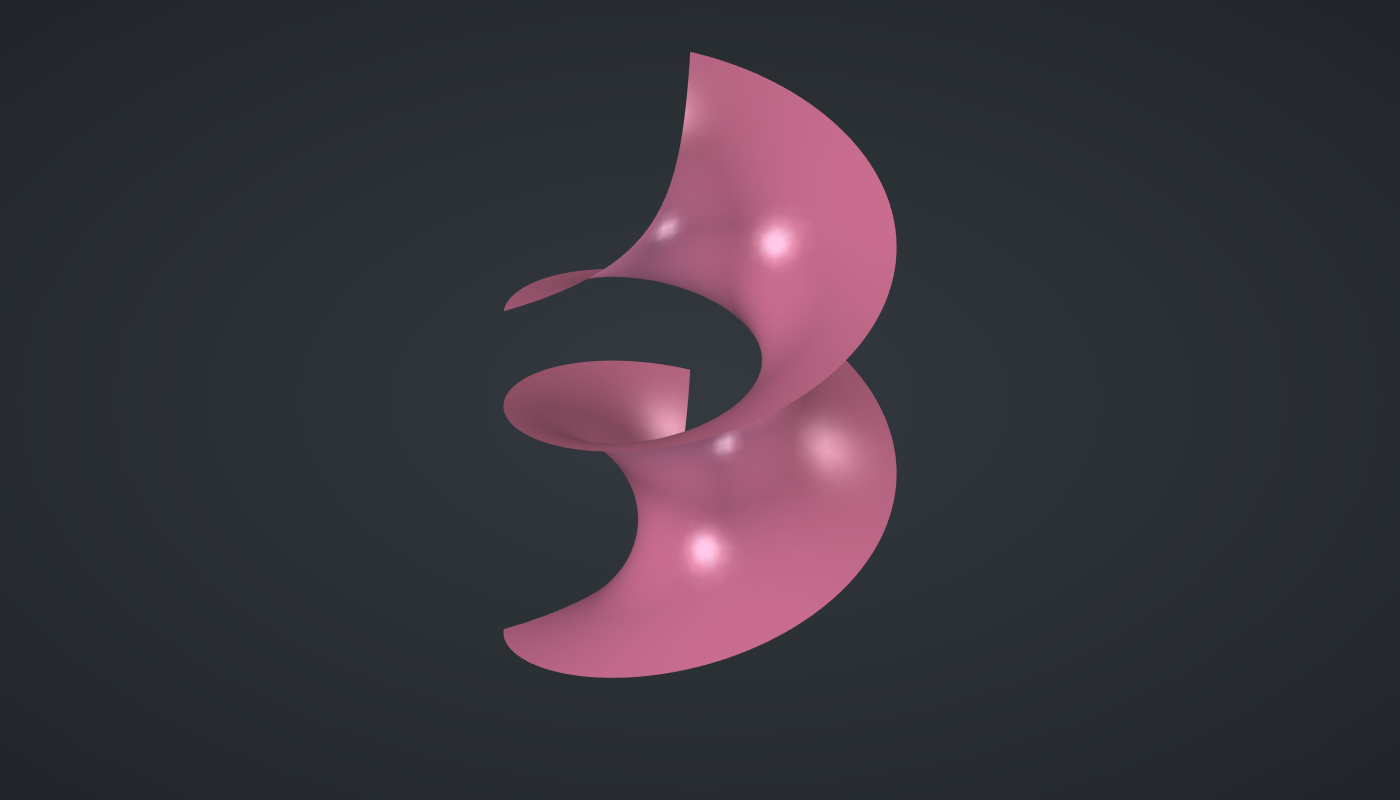
Reference: choose on the canvas toolbar to load the finished definition.
Build it
-
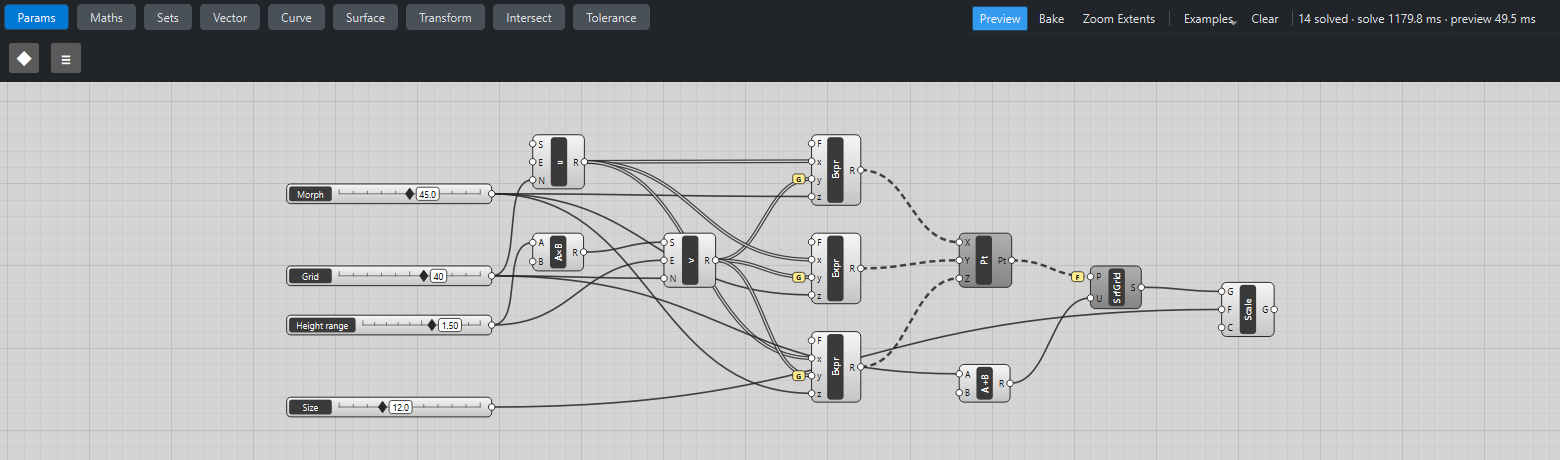
Place four sliders: Morph: 45 (0 – 90), Grid: 40 (10 – 60) with Decimals
0, Height range: 1.5 (0.5 – 2.2) with Decimals2, and Size: 12 (4 – 30). -
Place a Range (Maths), u, with S
-3.14159265, E3.14159265and Grid → N. Place a Multiplication (Height range ×-1) and a Range, v, from it to Height range with Grid → N. -
Place three Expression (Maths) components with u → x, v → y (Graft on y) and Morph → z:
-
cos(radians(z))*sinh(y)*sin(x) + sin(radians(z))*cosh(y)*cos(x) -
-cos(radians(z))*sinh(y)*cos(x) + sin(radians(z))*cosh(y)*sin(x) -
x*cos(radians(z)) + y*sin(radians(z))
-
-
Wire them into a Construct Point (Vector), then a Surface From Points (Surface) with Flatten on P and Grid + 1 (an Addition) as U.
-
Place a Scale (Transform) with the surface → G and Size → F.
-
Turn Preview off on Construct Point and Surface From Points.
What is happening
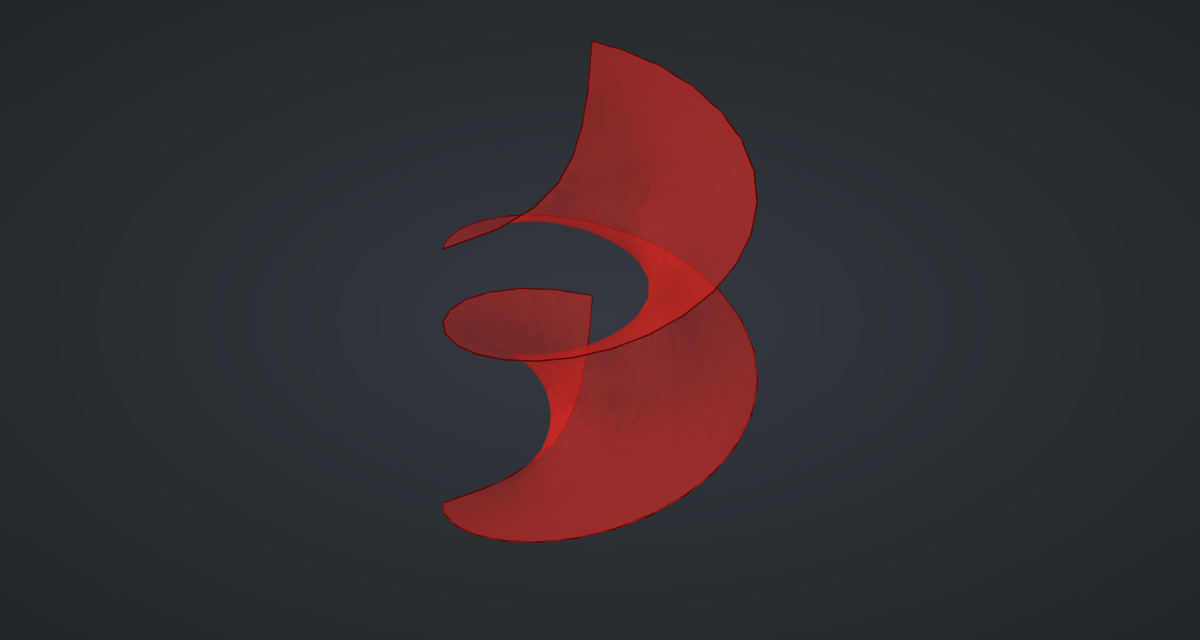
At Morph 0 the formulas reduce to (sinh v sin u, −sinh v cos u, u): a helicoid, a straight line turning as it rises. At 90 they become (cosh v cos u, cosh v sin u, v): a catenoid, circles of radius cosh v stacked up. In between, the surface twists from one to the other while every curve on it keeps its length. You can bend a catenoid into a helicoid without stretching it, the way you can roll paper into a tube. The geometry tests check that the surface follows the formula to within a thousandth.
Each update takes about a second.
Things to try
-
Drag Morph slowly from 0 to 90.
-
Raise Height range to 2.2 for a taller ramp and a flared catenoid.
-
Lower Grid to 15 to see how few points the smooth surface needs.