Sunflower seeds, pine cones and daisies all grow the same way: each new seed sits one golden angle, about 137.5°, round from the last, a little further out. Two formulas give the whole pattern. You will turn a list of seed numbers into positions with Expression, and see how sensitive the spirals are to that one angle.
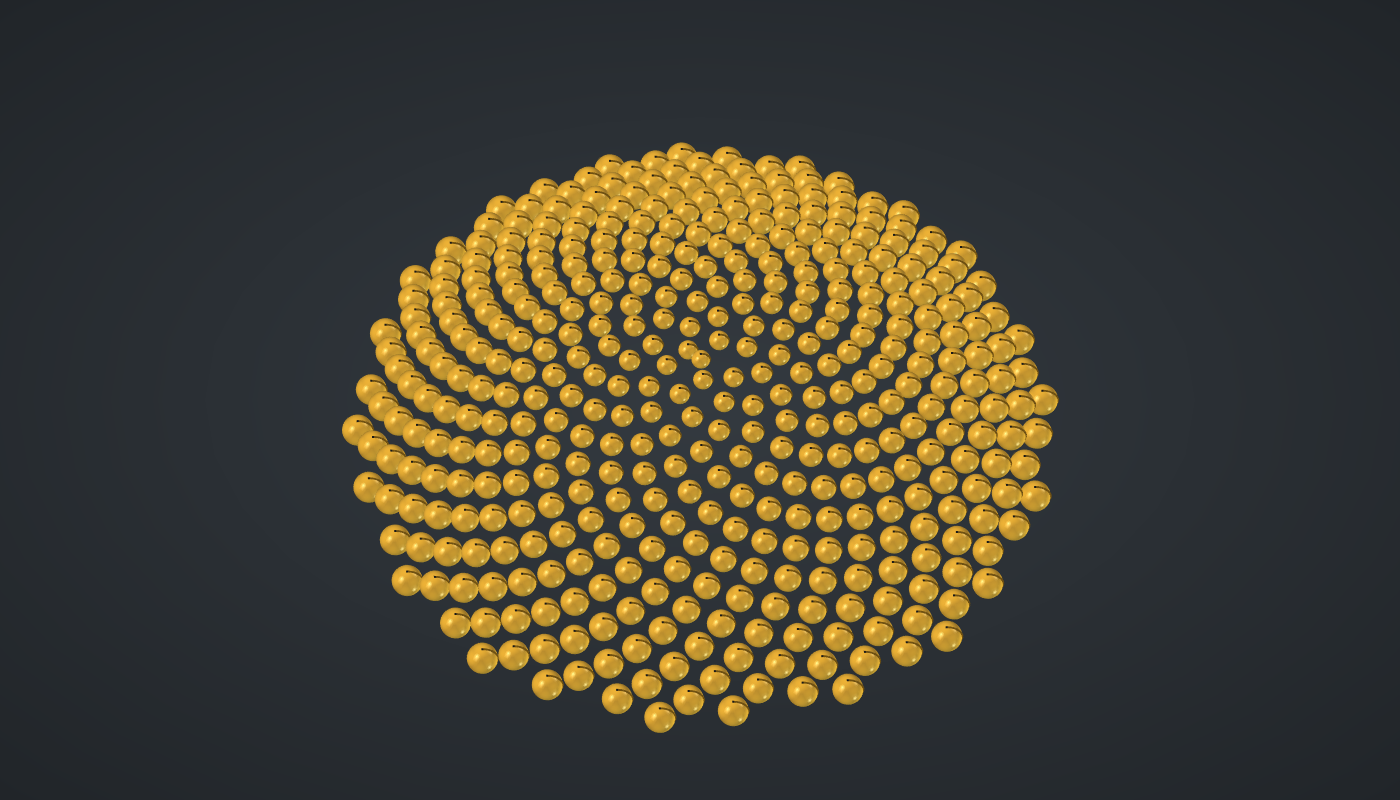
Reference: choose on the canvas toolbar to load the finished definition.
Build it
Seed numbers
-
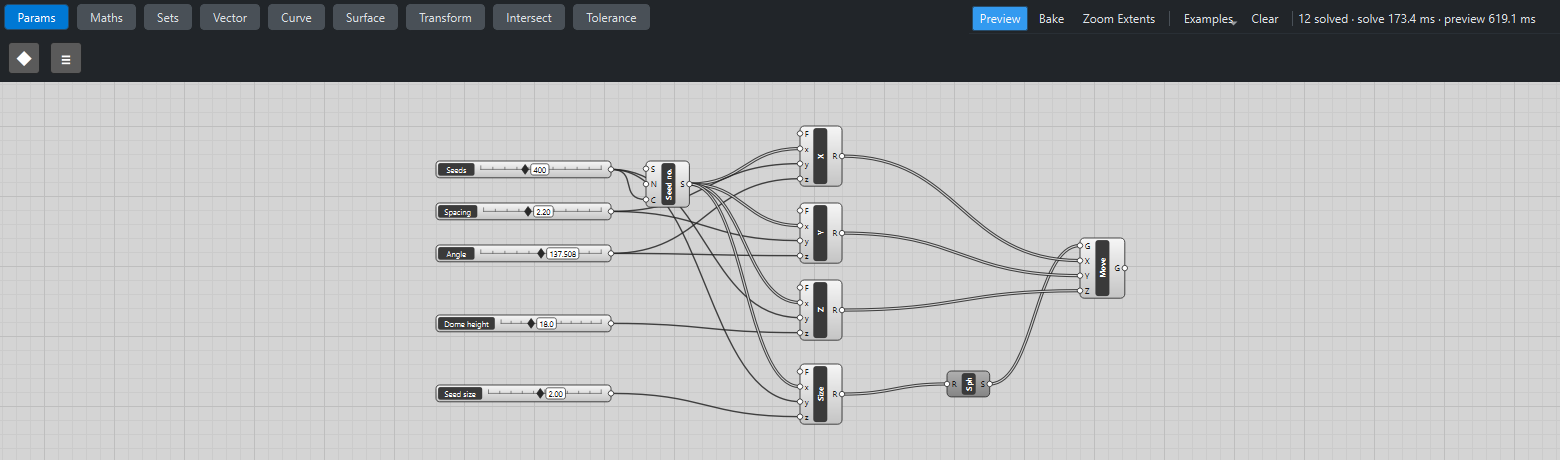
Place five sliders: Seeds: 400 (50 – 1000) with Decimals
0, Spacing: 2.2 (0.5 – 5) and Seed size: 2 (0.3 – 4) with Decimals2, Angle: 137.508 (130 – 145) with Decimals3, and Dome height: 18 (0 – 60). -
Place a Series (Sets), Seed no., and wire Seeds → C: the numbers 0 … 399.
Positions
-
Place an Expression (Maths), X, with F set to
y*sqrt(x)cos(radians(x*z)). Wire *Seed no. → x, Spacing → y and Angle → z. -
Place a second Expression, Y, with F set to
y*sqrt(x)*sin(radians(x*z))and the same three wires. Seed n now sits at angle n × 137.508° and radius 2.2 × √n. -
Place a third Expression, Z, with F set to
z*(1 - x/y). Wire Seed no. → x, Seeds → y and Dome height → z. The first seed sits 18 mm up, the last at 0: a shallow dome.
Seeds
-
Place a fourth Expression, Size, with F set to
z*(0.6 + 0.4*sqrt(x/y)). Wire Seed no. → x, Seeds → y and Seed size → z. Young seeds in the middle are smaller. -
Place a Sphere (Surface) and wire Size R → R: 400 spheres at the origin.
-
Place a Move (Transform). Wire Sphere S → G, X R → X, Y R → Y and Z R → Z. Each sphere moves to its own seed position.
-
Turn Preview off on Sphere.
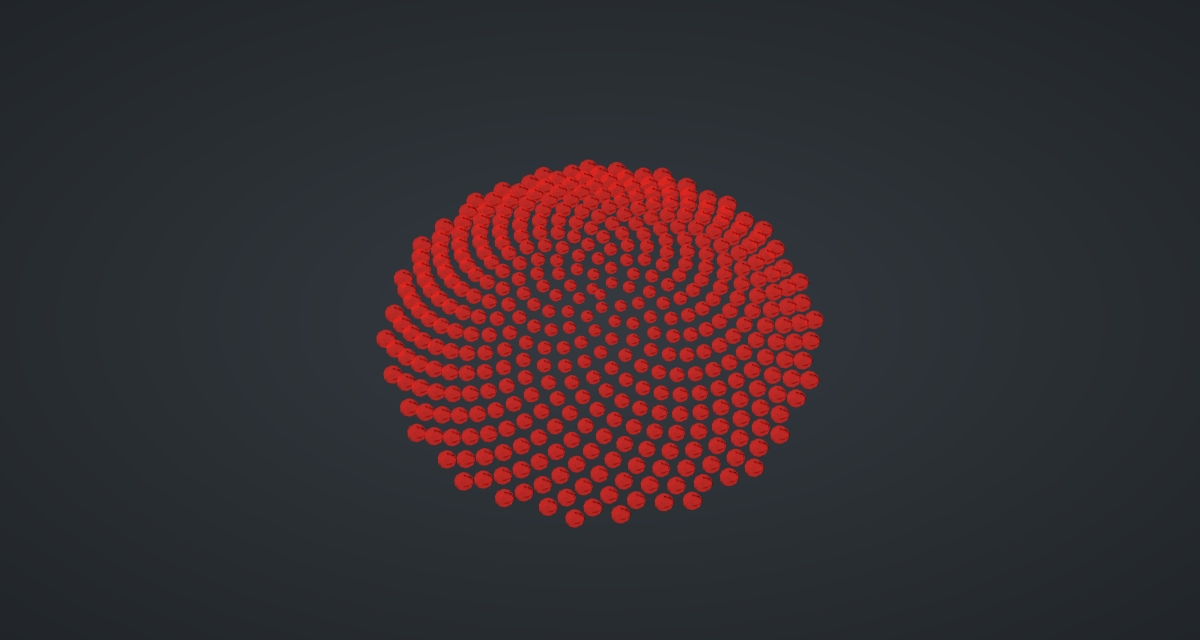
What is happening
Why √n? Each seed needs the same area. The first n seeds fill a disc of area proportional to n, so its radius grows with √n and the seeds pack evenly from the middle to the rim.
Why 137.5°? It divides the circle in the golden ratio, the "most irrational" number. Any simple fraction of a turn would line the seeds up in straight spokes with gaps between them; the golden angle never lines them up, so every new seed lands in the biggest gap left. The spirals you see, 13, 21 or 34 of them depending on where you look, are Fibonacci numbers, and they appear on their own: nothing in the definition draws a spiral.
Each update takes just under a second: about 0.15 s to solve, the rest to mesh 400 spheres for the preview. With this many curved faces the preview uses a coarser mesh; baked seeds are smooth.
Things to try
-
Drag Angle slowly. At 137.508 the seeds pack tightly; a few tenths of a degree off, gaps open and the seeds line up in curved spokes. At 135° (3/8 of a turn) they form eight straight arms.
-
Raise Seeds to 1000 for a full sunflower head.
-
Set Dome height to 0 for a flat daisy, or to 60 for a pine cone.
-
Replace the Sphere with a Center Box for square seeds, or with a small Cylinder for pins in a cushion.